Thursday, February 26, 2009

Lexington Hacker (the good kind) Workshop
Exciting news!
A group of computer programmers and engineering students are working on starting a hacker workshop in downtown lexington. The sort of spaces exist in a lot of places, and bring together a lot of creative and intelligent people to do cool things with electronics and share them with the world. Stay tuned for more updates!
A group of computer programmers and engineering students are working on starting a hacker workshop in downtown lexington. The sort of spaces exist in a lot of places, and bring together a lot of creative and intelligent people to do cool things with electronics and share them with the world. Stay tuned for more updates!
Wednesday, February 25, 2009
"Patrick, you're what my friend Jim calls an 'early adopter of obsolete technologies.' "
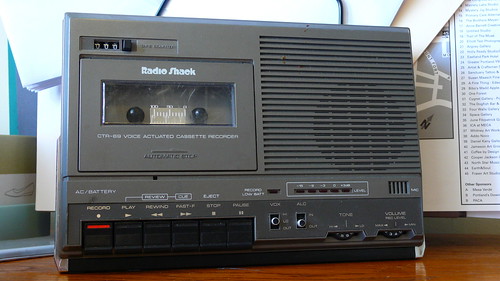
I've always been a fan of tapes. When I was a little kid, I used to take my father's cassette recorder into the basement and make little stories, using sound effects from TV shows and records to complete my imaginary radio plays. And until about 4 years ago (when it seems like all my friend's stereo tape decks disappeared and were replaced by ipods), I was a prolific mixtape maker, filling notebooks with tracklistings and spending hours making cover art for 90-minute packages of sonic love.
In the last year or so, I have discovered that I am not alone in my love of cassettes. In fact, a whole underground culture of musicians exists, and it is growing bigger each day. Which makes sense - cassettes are super cheap, abundant, durable, reusable, and have a unique tonal warmth that digital media will never have. Same goes for tape recorders - try to see how much digital recording equipment you can dig up at any Salvation Army for $10!
So, what does this have to do with libraries? Well, any decently run public or school library probably has about a dozen or so machines like the one pictured above sitting in a storage closet collecting dust. Rather than just burying these useful devices in the analog cemetary, librarians should be finding new uses for them. For example, over the last few months I have been taking a tape deck to concerts and making recordings of all sorts of interesting and creative local bands, which I have been archiving on my music blog. Librarians could be doing the same thing for poetry readings, speeches, and any other sort of event with audio involved.
The point is, librarianship shouldn't just be about shelving books and the newest gadgets. The most important mission for libraries is to archive culture, particularly local cultures. So librarians - grab that dusty radioshack deck and a few Harlequin romance audiobooks that are being thrown out, and start making some tapes!
Thursday, January 29, 2009
Low-Tech Services Libraries Should Give More Thought To
Being in the midst of an apocalyptic winter storm (myself without electricity for about 32 hours and counting) has gotten me thinking more than usual about the fragility of our current society, and the amazing lack of self-sufficiency endemic in our population. While technology and cheap energy have minimized the need for basic domestic survival skills for many, that era is fast approaching its end. I feel that as a librarians, in our role as gatekeepers of knowledge, we should be working to encourage the population to prepare for such eventualities. In particular, there are a few main areas that we (as a society) need to focus on:
1) Food: gardening, cooking, preserving/canning, hunting, organics and permaculture.
2) Technical skills: carpentry, woodworking, metallurgy, plumbing, recycling, alternative construction techniques, energy efficiency/alternative enegy.
3) Domestic skills: sewing, medicine, entertainment, art.
There are probably a lot more, but that is a good start.
What I propose is that the libraries of the future have dedicated DIY staffs (sort of like reference workers for how to jobs) that work with patrons, helping them find whatever resources they need to do something (say, building a tool shed or making jam), and who could also impart their own knowledge and skills. Larger libraries could even have workshops (say, a carpentry room in the basement), tool libraries, and other resources tailored to helping citizens become more self-reliant.
Thoughts?
1) Food: gardening, cooking, preserving/canning, hunting, organics and permaculture.
2) Technical skills: carpentry, woodworking, metallurgy, plumbing, recycling, alternative construction techniques, energy efficiency/alternative enegy.
3) Domestic skills: sewing, medicine, entertainment, art.
There are probably a lot more, but that is a good start.
What I propose is that the libraries of the future have dedicated DIY staffs (sort of like reference workers for how to jobs) that work with patrons, helping them find whatever resources they need to do something (say, building a tool shed or making jam), and who could also impart their own knowledge and skills. Larger libraries could even have workshops (say, a carpentry room in the basement), tool libraries, and other resources tailored to helping citizens become more self-reliant.
Thoughts?
Thursday, January 22, 2009
Whistleblower confirms Warrantless Wiretap Program Surveyed ALL U.S. Communications

Blow them whistles!
Wired has the scoop on the amazing/saddening/unsurprising revelation that the warrantless wiretapping program carried out by the NSA under the Bush administration placed ALL citizens under a surveillance dragnet.
2 things immediately struck me about this:
1) Why not sooner? Now, I realize this guy has already gone through a ton of crap for doing the right thing, and will likely go through more media-crucifiction at the hands of Bill O'Reilly and the likes... but seriously, why couldn't he have said this months or years ago when someone important could have actually been punished for it?
2)Why isn't this all over the front page of the New York Times, Washington Post, and other major news sources?
Library Tech That Is Not A Computer

That's right, a scooter.
The Chicago Metro Library System had the great idea of purchasing a scooter to help make their libraries more accessible to elderly patrons. Read all about it here.
Wednesday, January 21, 2009
The Right to Read
Just in case you were interested in pondering some of the darker "what-ifs" related to the digitization of media, here is Richard Stallman's magnificent short story/call to arms "The Right To Read."
Subscribe to:
Posts (Atom)
