Being a cantankerous semi-luddite, my favorite word in the English language slow. Rather than drawing up images of sluggish lines in the bank or simple minded idiots, my associations with the word slow run more along the lines of relaxed bike rides on a spring afternoon, BBQ ribs, small batch ales, and artisan cheeses. Things that involve care, a process, things that you savour and participate in fully, with no distractions. Thankfully, there are other people out there like me, and a whole "Slow Movement" has sprung up around the idea that slowness is health. I am especially fond of Slow Food and The Slow Bicycle Movement.
Well, now there is a whole SLOW READING movement, and a book recently published outlining its principles (thanks, Library Juice!). Here is excerpt from the 2nd chapter:
"Isaac Asimov (1969) tells a story of a future in which a character is asked to demonstrate his astonishing talent to the president. The talent is to perform basic mathematical calculations on paper without the aid of a computer. “‘Well’, said the president, considering, ‘it's an interesting parlor game, but what is the use of it?’” Many writers of fiction and non-fiction express fear that digital technology will render humans less intelligent. Calculations still get performed, but only by computers. People still access information, but through an implant that delivers it instantly. This kind of access to information is the dream of some information providers today, but it is not what we think of as literacy, and certainly not slow reading.
In the 1990s, society witnessed the mainstream integration of personal computers and the Web. For a time, it seemed likely that print, books and libraries would disappear, and perhaps literacy along with them. A generation later, we have some evidence by which to assess the reality. The analysis that follows shows that there is a close relationship between the media we use to read – books or digital technology – and the way we read and think. This is not to say that reading on screens spells the end of reading. Digital technology is often preferable for searching and scanning short snippets. However, print has endured because it is still the superior technology for reading anything of length, quality or substance. While digital technology lends itself to discovering and remixing ideas in novel ways, slow reading of books is still essential for nurturing literacy and the capacity for extended linear thought."
Full chapter here.
Showing posts with label lowtech. Show all posts
Showing posts with label lowtech. Show all posts
Thursday, March 26, 2009

Wednesday, February 25, 2009
"Patrick, you're what my friend Jim calls an 'early adopter of obsolete technologies.' "
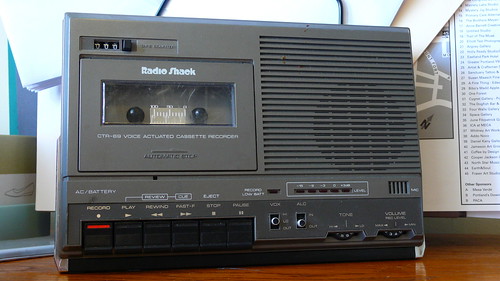
I've always been a fan of tapes. When I was a little kid, I used to take my father's cassette recorder into the basement and make little stories, using sound effects from TV shows and records to complete my imaginary radio plays. And until about 4 years ago (when it seems like all my friend's stereo tape decks disappeared and were replaced by ipods), I was a prolific mixtape maker, filling notebooks with tracklistings and spending hours making cover art for 90-minute packages of sonic love.
In the last year or so, I have discovered that I am not alone in my love of cassettes. In fact, a whole underground culture of musicians exists, and it is growing bigger each day. Which makes sense - cassettes are super cheap, abundant, durable, reusable, and have a unique tonal warmth that digital media will never have. Same goes for tape recorders - try to see how much digital recording equipment you can dig up at any Salvation Army for $10!
So, what does this have to do with libraries? Well, any decently run public or school library probably has about a dozen or so machines like the one pictured above sitting in a storage closet collecting dust. Rather than just burying these useful devices in the analog cemetary, librarians should be finding new uses for them. For example, over the last few months I have been taking a tape deck to concerts and making recordings of all sorts of interesting and creative local bands, which I have been archiving on my music blog. Librarians could be doing the same thing for poetry readings, speeches, and any other sort of event with audio involved.
The point is, librarianship shouldn't just be about shelving books and the newest gadgets. The most important mission for libraries is to archive culture, particularly local cultures. So librarians - grab that dusty radioshack deck and a few Harlequin romance audiobooks that are being thrown out, and start making some tapes!
Thursday, January 29, 2009
Low-Tech Services Libraries Should Give More Thought To
Being in the midst of an apocalyptic winter storm (myself without electricity for about 32 hours and counting) has gotten me thinking more than usual about the fragility of our current society, and the amazing lack of self-sufficiency endemic in our population. While technology and cheap energy have minimized the need for basic domestic survival skills for many, that era is fast approaching its end. I feel that as a librarians, in our role as gatekeepers of knowledge, we should be working to encourage the population to prepare for such eventualities. In particular, there are a few main areas that we (as a society) need to focus on:
1) Food: gardening, cooking, preserving/canning, hunting, organics and permaculture.
2) Technical skills: carpentry, woodworking, metallurgy, plumbing, recycling, alternative construction techniques, energy efficiency/alternative enegy.
3) Domestic skills: sewing, medicine, entertainment, art.
There are probably a lot more, but that is a good start.
What I propose is that the libraries of the future have dedicated DIY staffs (sort of like reference workers for how to jobs) that work with patrons, helping them find whatever resources they need to do something (say, building a tool shed or making jam), and who could also impart their own knowledge and skills. Larger libraries could even have workshops (say, a carpentry room in the basement), tool libraries, and other resources tailored to helping citizens become more self-reliant.
Thoughts?
1) Food: gardening, cooking, preserving/canning, hunting, organics and permaculture.
2) Technical skills: carpentry, woodworking, metallurgy, plumbing, recycling, alternative construction techniques, energy efficiency/alternative enegy.
3) Domestic skills: sewing, medicine, entertainment, art.
There are probably a lot more, but that is a good start.
What I propose is that the libraries of the future have dedicated DIY staffs (sort of like reference workers for how to jobs) that work with patrons, helping them find whatever resources they need to do something (say, building a tool shed or making jam), and who could also impart their own knowledge and skills. Larger libraries could even have workshops (say, a carpentry room in the basement), tool libraries, and other resources tailored to helping citizens become more self-reliant.
Thoughts?
Subscribe to:
Posts (Atom)
